Insight
Assistive
Decision model. Clinicians retain final diagnostic authority.
Use case
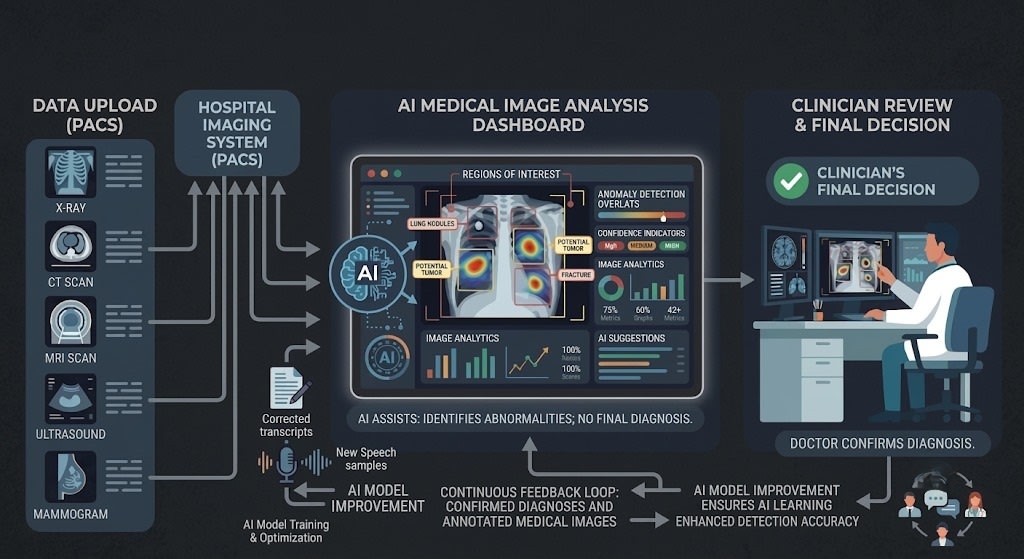
Radiantze vision models highlight regions of interest inside the reading workflow. Clinicians keep the final call.
Radiantze builds assistive vision models that highlight candidate regions, attach confidence scores, and log every inference inside the clinical reading workflow.
Validation, audit trails, and human sign-off stay in place. Clinicians retain diagnostic authority. The model surfaces findings for review inside existing PACS tools.
Insight
Decision model. Clinicians retain final diagnostic authority.
Insight
Workflow fit. Highlights appear inside existing reading tools.
Insight
Governance. Performance tested against institutional protocols.
Partnership
Clinical vision AI requires validation rigor, institutional review, and explicit escalation for low-confidence findings.
Outcome
Clinicians triage studies faster while accountability and institutional review standards stay fully intact.
Fine-tuned on institution-specific imaging data so highlights match local case mix and protocols.
Region highlights appear inside the reader workflow clinicians already use for diagnosis.
Every inference recorded with clinician disposition for governance and later performance review.